
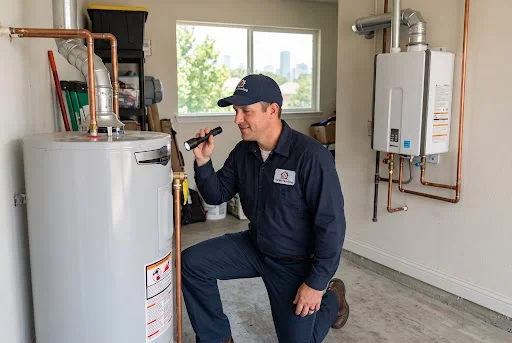
How long does a water heater last? For a regular tank model, you’re usually looking at somewhere in the 8 to 12 year range, give or take, before it starts giving you trouble. A tankless unit that gets descaled on schedule can go 20 years, sometimes more. The U.S. Department of Energy gives storage tanks a 10 to 15 year range nationally. Houston is a different story. Hard water, attics that bake all summer, and tanks nobody has flushed since move-in day tend to drag that number down.
So if yours is pushing 10, start planning now, because it’s a lot better than walking into the garage some morning and finding an inch of water on the floor. What follows covers how long each type tends to last, what wears them out around here, how to read the age off the label, and when paying for a repair still makes sense versus just replacing the thing.
Key Takeaways
- Tank units: in most Houston-area homes you’ll get somewhere around 8 to 12 years. Gas usually goes first; electric often hangs on a few years longer.
- Tankless can run 20+ years, as long as somebody descales it.
- The usual culprits here: hard water, attic and garage heat, humidity, and high water pressure.
- Your unit’s age is hiding in the serial number on the rating plate.
- A yearly flush and an anode rod check every few years buy the most extra life.
How Long Do Water Heaters Last by Type?
Type matters more than brand or tank size. Here’s roughly what to expect.
| Water heater type | Typical lifespan | What usually ends it |
|---|---|---|
| Gas tank | 8 to 12 years | Sediment buildup and corrosion at the bottom of the tank |
| Electric tank | 10 to 15 years | Tank corrosion; heating elements wear out but can be replaced |
| Tankless (gas) | 20+ years | Scale inside the heat exchanger when descaling is skipped |
| Heat pump (hybrid) | 10 to 15 years | Compressor or tank failure |
Gas tanks usually go first. How long does a gas water heater last? Somewhere around 8 to 12 years is pretty typical, though some quit sooner than that. The reason is pretty simple. The burner sits right under the tank, and the bottom of the tank is exactly where sediment piles up, so that layer ends up holding heat against the steel and the steel corrodes faster there than anywhere else on the unit.
Electric tanks tend to hang on a bit longer since there’s no flame underneath. And when one quits heating, it’s often just a heating element or a thermostat. Both can be swapped out.
Tankless units don’t have a tank to rust through. That’s the whole reason they outlast tanks by such a wide margin. Their weak spot in Houston? Scale. Minerals build up inside the heat exchanger, and if nobody descales it, the unit struggles. Family Plumbing installs and services Rinnai and Navien gas tankless systems. There’s more on the tankless water heater services page.
Why Water Heaters Wear Out Faster in Houston
A water heater in Houston has a harder life than one in a mild, soft-water town. Five things do most of the damage.
Hard water and sediment
Hardness depends on who supplies your water. Plenty of homes in Cypress, Copperfield, and the neighborhoods around them get their water from a municipal utility district (MUD) rather than the City of Houston, and one MUD’s water can test differently from the next one over. Every supplier puts out a yearly Consumer Confidence Report, and that’s usually where you’ll find the hardness numbers. Why does it matter? Heat hard water and the calcium and magnesium come out of it. In a tank, they settle on the bottom as sediment. In a tankless unit they end up as scale stuck to the inside of the heat exchanger, and in both cases the heater has to work harder to do the same job, which is what wears it out early.
Attic and garage installations
Lots of Houston-area water heaters live in the garage or the attic. Garage units roast through a Houston August and then get chilled every time a cold snap rolls through, which is a lot of heating and cooling for one steel tank to absorb over ten years. Attic units are the bigger worry. When an attic tank lets go, the water comes through the ceiling. That’s why age matters more up there: waiting costs a lot more. Any attic install needs a drain pan and a drain line that actually works.
Gulf Coast humidity
Humidity rusts things. Simple as that. In a garage you’ll often see rust on the gas valve, the water connections, and the outer jacket of the tank. Surface rust on the jacket isn’t always a big deal. Rust at the water connections or around the base is another story, so get that looked at.
High water pressure and thermal expansion
Water expands when it heats up. If your home has a pressure-reducing valve or a backflow device on the main line, that extra volume has nowhere to go unless there’s an expansion tank. Without one, every single heating cycle sends a small pressure spike through the tank, the fittings, and the temperature and pressure relief valve, and a water heater runs a lot of heating cycles in a year. Over the years, that adds up.
Skipped maintenance
Most tanks never get flushed. Not once. Sediment piles up, the anode rod wears down to bare wire, and the tank fails years early. Those two things, sediment and a spent anode rod, cause more early failures than anything else.
How to Find the Age of Your Water Heater
Look for the rating plate. On a tank it’s the label on the side; on a tankless unit it’s on the front. The serial number almost always has the build month and year baked in. Each manufacturer does it a little differently. Some use the first four digits. Others use letters. If the code doesn’t make any sense to you (and a lot of the time it won’t), the manufacturer can decode it, either on their website or over the phone.
It’s worth jotting down the gallon size and fuel type while you’re looking at the label, too, since you’ll want those if it turns out you need a replacement. And if the label’s too faded to read, or the tank is wedged somewhere in the back of a sweltering attic you’d rather not crawl into, a plumber can read it for you during a service call.
Signs a Water Heater Is Near the End of Its Life
Age is the first clue. It’s rarely the only one. Keep an eye out for:
- Rusty or discolored hot water
- Rumbling or popping while it heats
- Water pooling at the base
- Hot water running out sooner than it used to
- A tank past 10 that keeps needing repairs
Any of these on an older tank? Get somebody to look at it while it’s still working, because dealing with it now is a lot less of a headache than dealing with it after it’s flooded something.
Repair or Replace: A Simple Rule for Houston Homeowners
A problem doesn’t automatically mean a new water heater. Here’s a rough way to think it through.
If the unit is under about 6 years old, it’s usually worth fixing. Things like a bad thermostat, a heating element, a thermocouple, or the gas valve are pretty routine repairs, and replacing a young tank over one of them would be throwing money away.
If the tank itself is leaking, though, that’s the end of the road for it. There’s no patching a tank body, and the leak only gets worse.
At 8 years or older with a big repair quote in hand, do the math. A decent rule of thumb is that once the repair gets past roughly half of what a new unit would cost, you’re usually better off putting that money toward the new one.
And before you decide anything, look up the warranty. Depending on the model it might run anywhere from 6 to 12 years, and if yours is still covered you could end up paying for labor and not a whole lot else.
If you’d like a straight repair-or-replace call on your own unit, the water heater repair and replacement page has more on how Family Plumbing handles it, or you can just pick up the phone and call.
How to Make a Water Heater Last Longer
None of this is complicated, it’s mostly just a matter of remembering to do it.
- Flush the tank about once a year. Hard water? Every six months isn’t overkill.
- Check the anode rod every 2 to 3 years. It’s basically there to corrode so the tank doesn’t have to, and if you’ve got a water softener it’ll get eaten up faster than usual.
- Test the temperature and pressure relief valve every so often, however often the manual for your model says to.
- Keep the thermostat at 120°F. That’s what the Department of Energy recommends for most homes, and the tank doesn’t have to work as hard at that setting.
- If the house has a closed plumbing system, an expansion tank is worth adding (the pressure section above explains why).
- Descale a tankless unit on whatever schedule the manufacturer gives you, and a bit more often than that if your water runs hard.
Frequently Asked Questions about Water Heaters
How long does a 50-gallon water heater last?
Pretty much the same as a 40-gallon, so usually 8 to 12 years. The size of the tank doesn’t change much on its own; what really matters is the fuel type, how hard your water is, and whether anybody is keeping up with maintenance.
How long does an electric water heater last?
Usually 10 to 15 years. What tends to go first is a heating element or the thermostat, and the good news is that either one can be replaced without replacing the whole tank.
Will a bigger tank last longer?
Not by itself, no. A tank that’s the right size for the house, gets flushed, and still has a decent anode rod in it is going to outlive a bigger one that nobody ever touches.
Is a 10-year lifespan for a water heater accurate?
As a midpoint for a tank, sure. Some die at 6 in hard water. Others run past 15. Once yours is past 10, it’s time to at least start thinking about what you’d replace it with.
How long will a leaking water heater last?
There’s really no way to know. If the drip is coming from a fitting or a valve, that can often be fixed. If it’s coming from the tank body, it might hold for a while or it might let go all at once, so shut off the water going to the tank and get a plumber out to look at it.
Why do water heaters fail so quickly?
Most of the time it comes down to sediment, a worn-out anode rod, high water pressure, or a bad install. Houston’s hard water makes the first two worse.
My water heater is 20 years old. How much longer will it last?
Honestly? It’s on borrowed time. At 20 it’s way past what anyone would expect out of a tank, and it could quit any day now. Replace it on your terms, especially if it’s in the attic.
How long does a Rheem water heater last?
About the same as the other big tank brands, so 8 to 12 years in most cases. How long the warranty runs depends on which model you have, and how the tank has been taken care of matters more than whose name is on it.
How long does a Bradford White water heater last?
Also 8 to 12 years, typically. If you want to figure out how old yours is, the year and month it was built are coded as letters at the start of the serial number, and Bradford White explains how to read them on its website.
How long does it take to replace a water heater?
If it’s just swapping one standard tank for another, that’s often done in a few hours. It takes longer when the tank is up in the attic, when the venting or gas line needs changing, when there are code updates to bring it up to, or when you’re going from a tank to tankless.
Get a Straight Answer on Your Water Heater
Every water heater wears out eventually, and around Houston they tend to get there a little quicker. If you know roughly how old yours is, keep an eye out for the warning signs, and stay on top of flushing and anode checks, you get to replace it when it’s convenient instead of the day it floods the garage.
Family Plumbing is a licensed Texas plumbing company based right here in Cypress (Texas Master Plumber license RMP #46423), and water heaters, both tank and tankless, are its specialty. Give us a call at 832-334-6389, or book online if that’s easier. We do inspections, repairs, and replacements all over Cypress and northwest Houston.
