
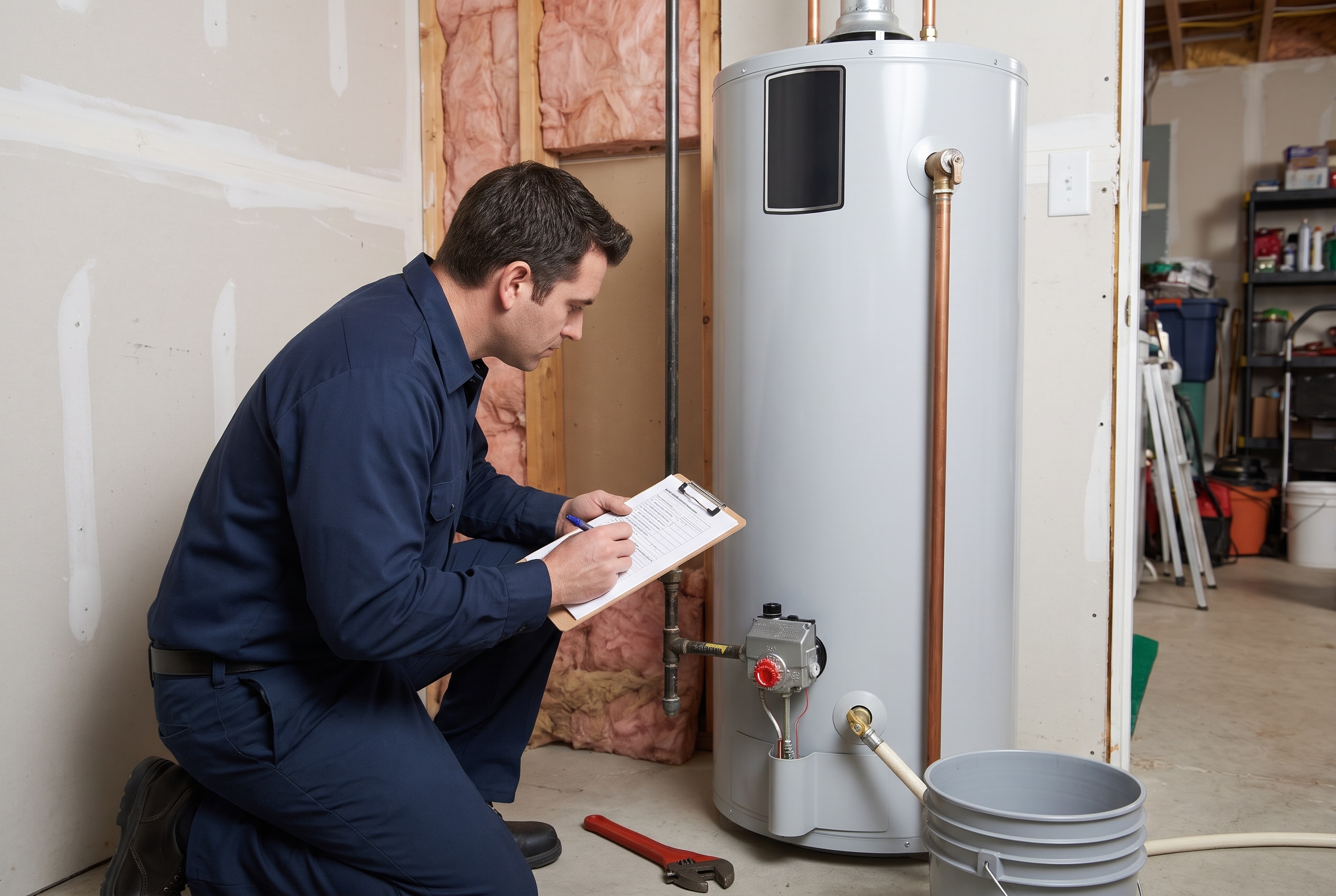
A water heater maintenance checklist really comes down to two jobs.
Check the anode rod every year or two, and flush the sediment out once a year. That’s most of it. They’re also the two things almost nobody does, which is why so many tanks in northwest Houston quit years before they should.
Want someone else to handle it? Family Plumbing does water heater maintenance service across Cypress, Jersey Village, Copperfield, and Tomball. Call 832-334-6389.
Why do these two jobs matter so much?
Your tank is steel with a glass lining inside. That lining’s never perfect. There are tiny gaps from the day it leaves the factory, and hot water goes straight for bare steel.
Two things slow that down. A healthy anode rod, and a tank bottom that isn’t buried in sediment.
Lose both, and you’ll usually find out the hard way: water pooling under the tank. No fix for that. It’s a replacement.
The anode rod check
What’s that rod actually doing?
Think of it as a decoy. It’s a long magnesium or aluminum rod screwed into the top of the tank, hanging down most of the way to the bottom. Those metals corrode more easily than steel, so the water chews on the rod first (that’s why plumbers call it a sacrificial anode). As long as there’s rod left, the tank’s protected.
Some tanks have a hex head on top you can see. Others hide the anode inside the hot water outlet fitting. Same job, harder to get at.
How often should you replace the anode rod?
Many manufacturers say inspect it every one to two years and replace as needed. A rod often lasts three to five years. Often. Not always.
It goes faster when:
- Water softener in the house. Softened water eats rods quicker. Sometimes a lot quicker.
- The water’s hard, and the household runs through plenty of hot water every day.
Pull out the owner’s manual and check the interval there too. Maintenance terms can tie into warranty coverage, so it’s worth a two-minute look.
How do you know it’s used up?
- Exposed core wire. There’s a steel wire down the center of every rod. When roughly six inches of it is showing, or the rod’s pitted down to a skinny stick, it’s done.
- A rotten egg smell from the hot water only (cold smells fine). That’s usually bacteria reacting with a magnesium rod. An aluminum-zinc rod or a powered anode typically clears it up.
- Rusty hot water. Could be the rod. Could be old galvanized pipe. Worth checking either way.
- No rod at all. It happens. Someone pulls it to kill the smell and never puts one back, and now the tank has zero protection.
That last one’s more common than you’d think.
Checking it yourself
Handy? You can do this. Just know where to quit.
- Kill the heat. Breaker off for electric. Gas valve to pilot or vacation.
- Close the cold supply valve on top of the heater.
- Open a hot faucet somewhere in the house to let the pressure off.
- Drain a few gallons from the drain valve so the water sits below the top of the tank.
- Break the rod loose. Most take a 1-1/16 inch socket, and you’ll want a breaker bar, because these things are often stuck tight.
- Look it over. Exposed wire? Thin as a pencil?
- Put it back (or put in a new one) with fresh thread sealant. Refill, bleed the air at a hot faucet, then turn the heat back on.
Time to stop and call a plumber:
- The rod won’t budge, and the whole tank starts twisting. Don’t muscle it. You can wreck the fittings.
- You can’t pull it straight out because the ceiling’s too low, or there’s no hex head to grab because it’s built into the outlet. Both are fixable. Just not a first-timer job.
The annual flush
What’s sediment doing in there?
Minerals drop out of the water and settle on the bottom. Year after year. Harder water, faster pile-up.
- Gas heaters have the burner right under the tank. Sediment sits between the flame and the water like a blanket, so the burner runs longer and cooks the tank bottom. More gas, less hot water. That popping and rumbling you hear? Water trapped under the crud, boiling its way out.
- On an electric heater, the lower element can get buried and burn out early.
Not sure if your water’s hard? Look at your faucets and showerheads. White crust means yes. For the real number, your utility or MUD puts out an annual water quality report that lists hardness.
How often should you flush a water heater?
Once a year is the usual call for a tank. Hard water? Twice a year might be smarter. And if it’s already popping, you’re behind.
How to flush a water heater
Set aside an hour or two. Most of it is waiting.
- Turn off the heat. Breaker for electric, pilot or vacation for gas.
- Let it cool. That water can scald you. Give it a few hours, or run through the hot water first.
- Close the cold supply valve.
- Hook a garden hose to the drain valve near the bottom. Run it to a floor drain or outside, somewhere lower than the valve.
- Open a hot faucet in the house so air can get in and the tank drains.
- Open the drain valve. Let it empty.
- Stir it up. With the drain still open, crack the cold supply on for a few seconds, then off. Again. The surge kicks sediment loose. Keep going until the hose runs clear.
- Close the drain valve and take the hose off.
- Refill. Open the cold supply and leave that hot faucet running until it flows steady with no sputtering. Now it’s full.
- Turn the heat back on. Electric owners, this matters: never restore power until the tank’s completely full. Elements that fire without water around them die in seconds.
- Check the drain valve for drips over the next day.
What about an older tank that’s never been flushed?
Careful here.
Eight or ten years of sediment can harden into a crust. Open that drain valve for the first time, and it might clog, and plastic valves don’t always seal again once they’ve been opened. Stirring up old buildup can also uncover weak spots the crud was quietly plugging.
So should you flush it? Probably, but watch it closely, or let a plumber do the first one with a spare drain valve ready. Already leaking? A flush won’t save it.
Quick yearly checks (10 minutes, tops)
- T&P relief valve. Lift the lever for a second. Hot water should shoot out the discharge pipe, and the valve should snap shut. If it keeps dripping, or nothing comes out at all, it needs replacing. Keep your hands and feet out of the way.
- Set the thermostat around 120°F. That’s what the U.S. Department of Energy recommends for most homes, and it cuts the scald risk too.
- Drain pan. Plenty of northwest Houston homes have the heater in the garage or attic, where a slow leak can drip for weeks before anyone notices. Look for water in the pan or rust at the fittings. Make sure the pan drain line is clear too.
- On gas units, the flame should be mostly blue. The vent pipe should be snug and angled up, with no gaps or rust.
- Smell gas? Get out of the house first, then call 911 or the gas company from outside. Don’t flip switches on the way out. Once the utility clears it, Family Plumbing handles gas line repair and leak testing.
Got a tankless?
Different list. Most residential tankless units have no anode rod and no tank to drain.
- Descaling. A small pump pushes descaling solution through the heat exchanger using the unit’s service valves. In hard water, scale is the big killer.
- Clean the inlet filter screen. It catches grit before it gets inside.
Rinnai and Navien both list maintenance intervals in their manuals, so follow those. Family Plumbing services Rinnai and Navien gas units; see tankless water heater service.
DIY or call a plumber?
Fine to do yourself:
- Testing the T&P valve
- Checking the thermostat
- Eyeballing the pan, fittings, flame, and vent
- Flushing a newer tank with a drain valve that turns easily
Better to call:
- Stuck anode rod.
- Low clearance over the tank
- An older tank that’s never been flushed
- Leaking from the bottom. Call now, not next week
- A rotten egg smell that keeps coming back
- Popping that sticks around even after a flush
- Any gas smell, ever
Frequently Asked Questions
Can I flush a water heater myself?
Usually, yes. Shut off the power or gas and let the water cool before you start. Then make sure the tank’s full before an electric unit goes back on. If it’s an older tank that’s never been flushed, or the plastic drain valve fights you, let a plumber do that first one.
How do I know if my water heater needs to be flushed?
Listen. Popping or rumbling while it heats is the giveaway. Hot water that runs out sooner than it used to points the same way. So does gritty or cloudy hot water, or a gas burner that seems to run forever. And if it’s been over a year since the last flush, it’s due no matter what it sounds like.
What happens if you don’t flush your water heater?
The sediment keeps stacking up. Gas units waste fuel and overheat the bottom of the tank; electric units can lose their lower element. All that extra heat and strain speeds up the rust that eventually turns into a leak.
Should I flush a 7-year-old water heater?
Depends on its history. Flushed regularly? Keep at it. Never touched? Hardened sediment can clog the drain valve or stop it from sealing again, and stirring it up can expose weak spots. A plumber with a spare valve on hand is the safer bet.
How long does it take to flush a water heater?
The flush itself, maybe 20 to 30 minutes. Budget an hour or two total, since you’re waiting on cool-down and refill.
How do I know if my anode rod needs replacing?
Pull it. If several inches of steel core wire are showing, or it’s pitted down to almost nothing, swap it. A rotten-egg smell or rusty hot water are hints, too.
How long can an anode rod last?
Often three to five years. But a water softener can cut that down a lot, and so can hard water combined with heavy daily use. The only way to really know is to pull it and look every year or two.
What happens if you don’t replace your anode rod?
The tank becomes the target. Once the rod’s gone, the steel starts rusting from the inside out, and it usually ends with a leak from the bottom. There’s no patching a tank like that. It gets replaced.
How much does a plumber charge to replace an anode rod?
Depends on the heater. The rod type matters, and so does whether the old one’s seized or boxed in by a low ceiling. Call Family Plumbing at 832-334-6389 for a price on your specific heater.
What regular maintenance should be done on a water heater?
For a tank, the short version: flush it yearly, check the anode rod every one to two years, test the T&P valve once a year, keep the thermostat near 120°F, and watch the drain pan and gas vent for trouble. Tankless units are different. They need descaling and a clean inlet filter instead.
Haven’t checked your anode rod in a while?
Let us do it.
Family Plumbing is a family-owned plumbing company in Cypress, led by a licensed Texas Master Plumber (RMP #46423). Water heaters are what we do best. We’ll pull the rod, flush the tank, and tell you straight whether your heater has years left or is close to done.
Call 832-334-6389 or book online. We serve Cypress, Jersey Village, Copperfield, and the rest of northwest Houston.
